Source29 / front reference
Original generated source · 30fps
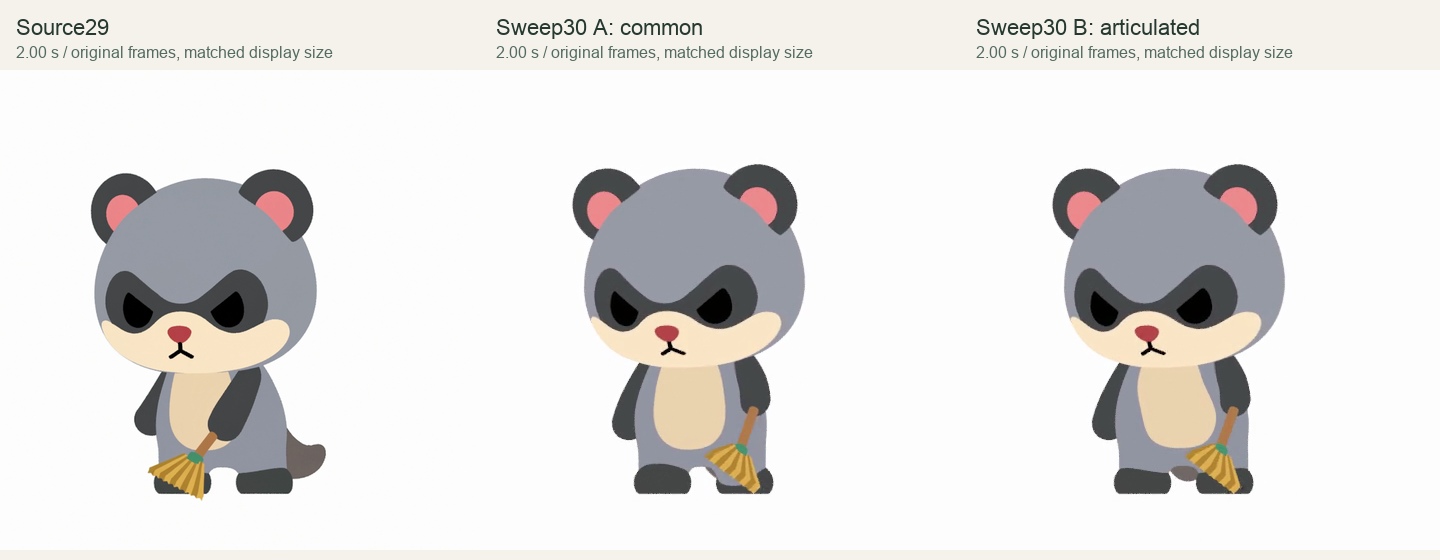
The reference reads as a coordinated body turn toward the non-holding side. Sweep30 adds chest–pelvis torsion, but misses much of the body travel, lower-belly movement and opposite-side sweep.
Analysis only. Original Source29 and Sweep30 A/B are unchanged. The non-holding-foot pivot is the next hypothesis to test; this single front view does not establish a unique hidden pivot or weight distribution.
B / source, normalized horizontal range. A projection cue, not a measured root translation.
B stays on the holding side. The source reaches the opposite foot region.
B suppresses the lower presentation. A is closer on this visible contour cue.
Original generated source · 30fps
Central pivot · no relative torso yaw or leg fade
Central pivot · relative yaw and leg fade enabled
All three videos share playback time. Source: 30fps; native A/B: 60fps. One frame step advances native time by 1/60s. Overlays: cyan = gray head envelope, pink = nose, green = broom binding, purple = left cream edge, blue = sampled exposed sole. These are image features, not a reconstructed skeleton.
The face-presentation cue already moves 113% as much as the reference, while the head-envelope midpoint and broom binding move only 50%. Increasing head or chest yaw alone does not address the missing body transport.
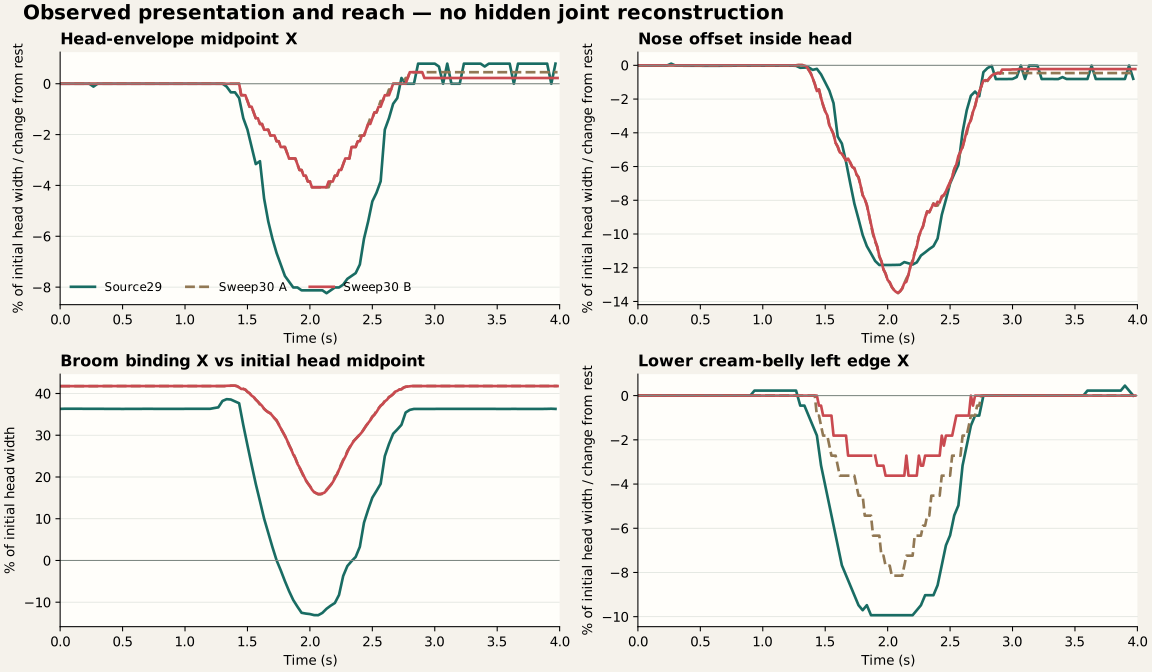
| Observable range / initial head width | Source29 | A common | B articulated | B / source |
|---|---|---|---|---|
| Gray head-envelope midpoint X | 9.03% | 4.52% | 4.52% | 50% |
| Nose offset within head X | 11.94% | 13.52% | 13.50% | 113% |
| Green broom binding X | 51.76% | 26.05% | 25.93% | 50% |
| Middle cream edge X | 7.67% | 6.33% | 2.71% | 35% |
| Lower cream edge X | 10.38% | 8.14% | 3.62% | 35% |
The non-holding foot's sampled outside edge and sole remain fixed in all 120 source frames, with stable results across three mask cutoffs. The holding sole is also fixed in 108 unoccluded samples; the other 12 are excluded. No step or lift is observed.
Both contacts staying planted does not identify which foot bears the load. A pivot-based rotation and a central rotation plus translation can also produce identical geometry. The useful next test is a contact-relative body mechanism, not a claim to have recovered an invisible joint.
Planted contacts → common trunk/pelvis transport → gray-leg and hip accommodation → local arm reach and head attention → optional residual torso twist.
The trunk may move mostly as one unit while both feet stay fixed. The legs must accommodate that relationship; rigidly rotating the whole character including both paws would violate the contact task.
First compare a central common-body case with a non-holding-contact case using the same local arm/head scores. Let the shoulder and tool move with the changed body frame. Only then test a small chest correction. Keep leg accommodation equal when isolating torso twist.
Read the full evidence report · Read the next experiment design · Original Sweep30 rig comparison and editable native
The holding-side inner edge is threshold-sensitive (2px at dark cutoffs 90/100; 11px at 110). It is not an exact paw-motion bound. Obstructed points are omitted. Exact sole/edge statements concern only the sampled visible regions.
All measured features and thresholds · Controller audit · Visual review record · SHA256 manifest
Analysis script · Unchanged Sweep30 math · Unchanged Sweep30 native builder · Audit plan
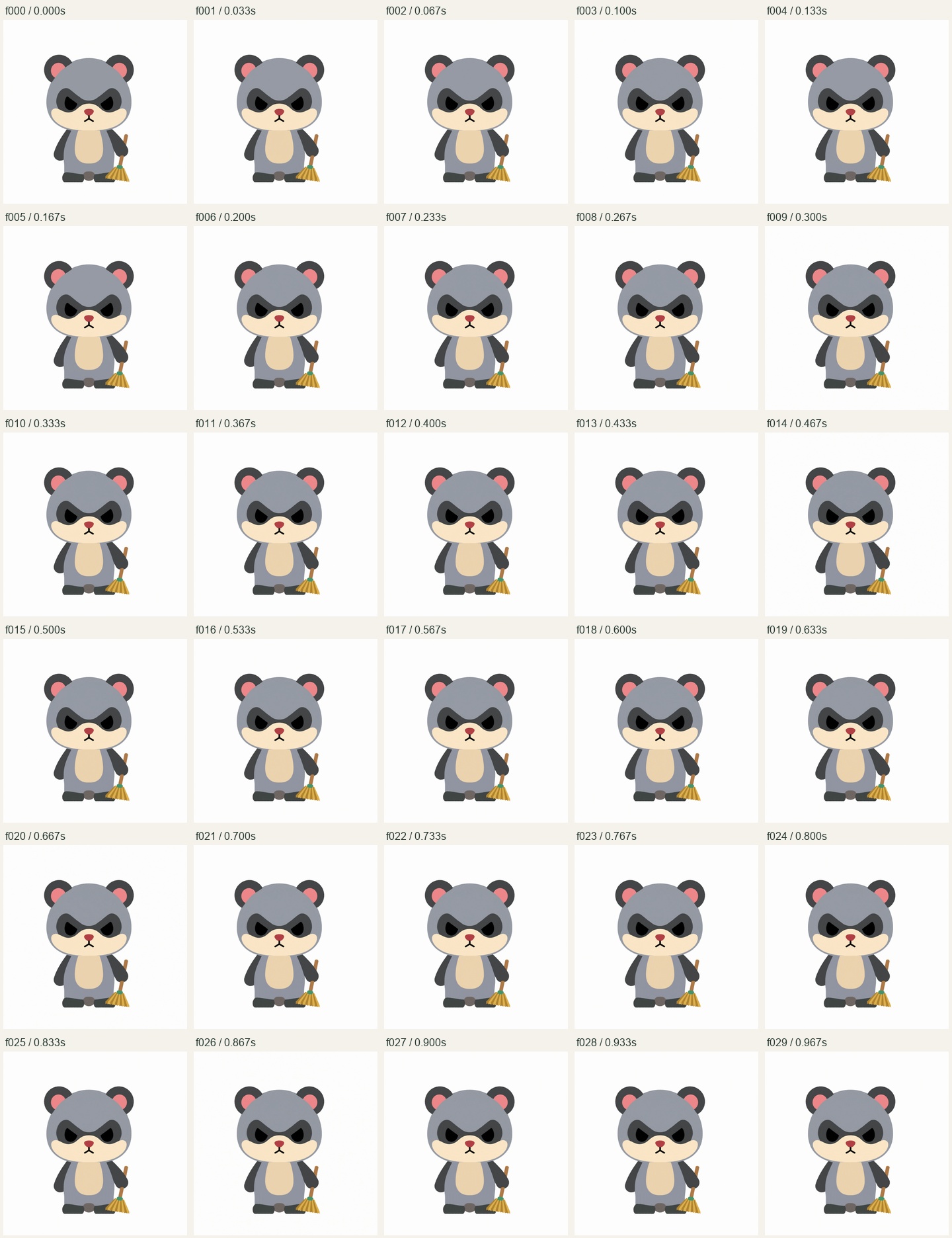 Source frames 0–29
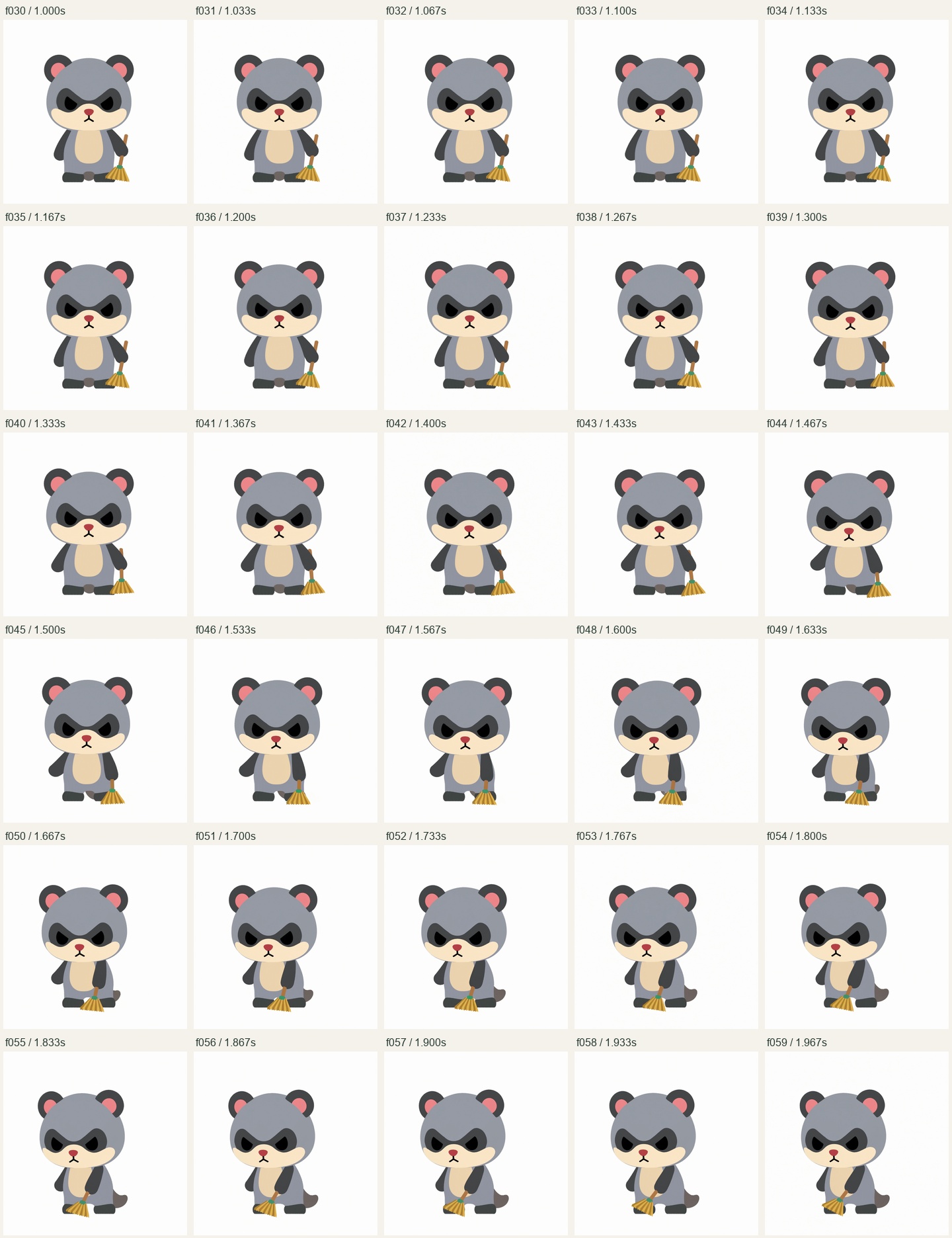 Source frames 30–59
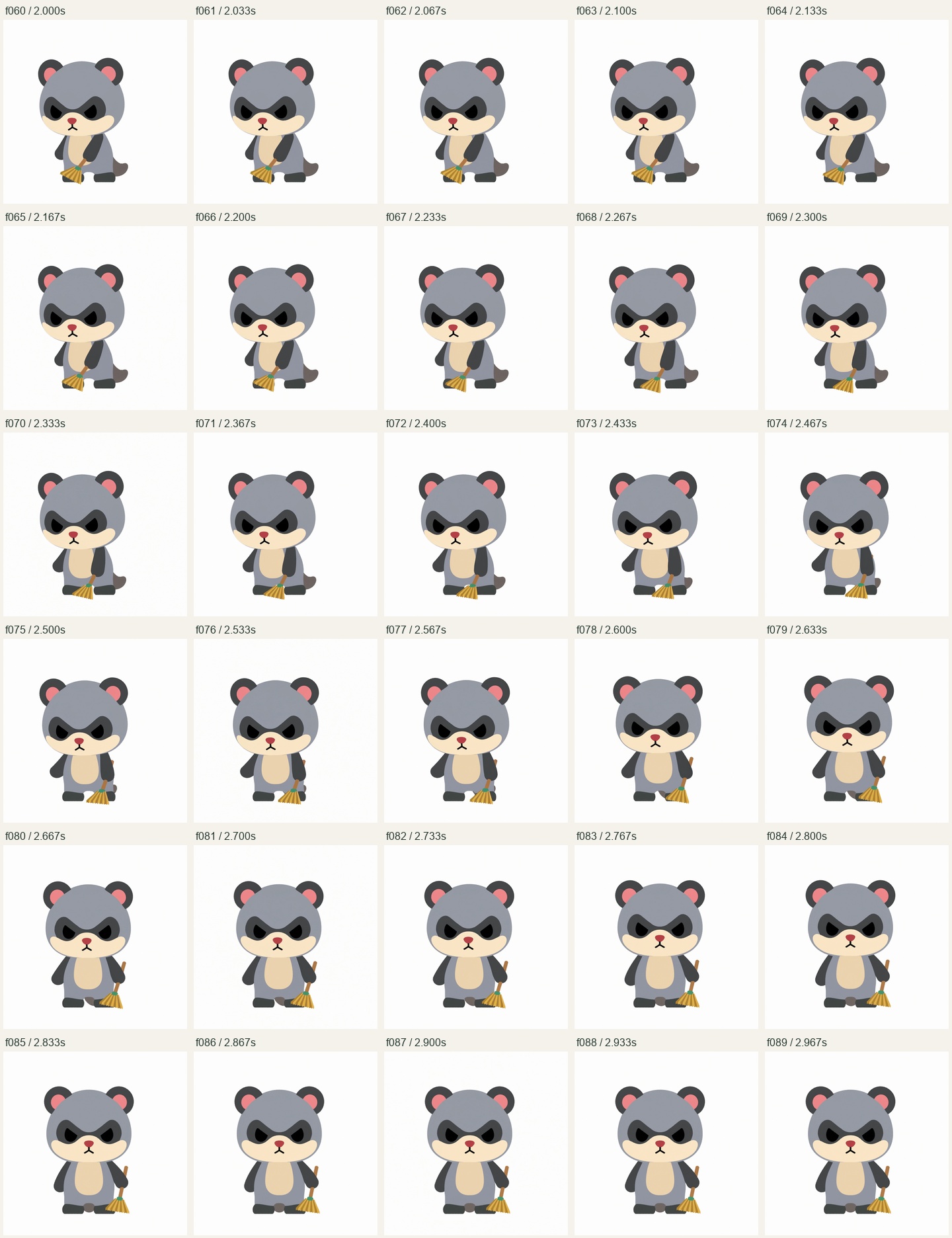 Source frames 60–89
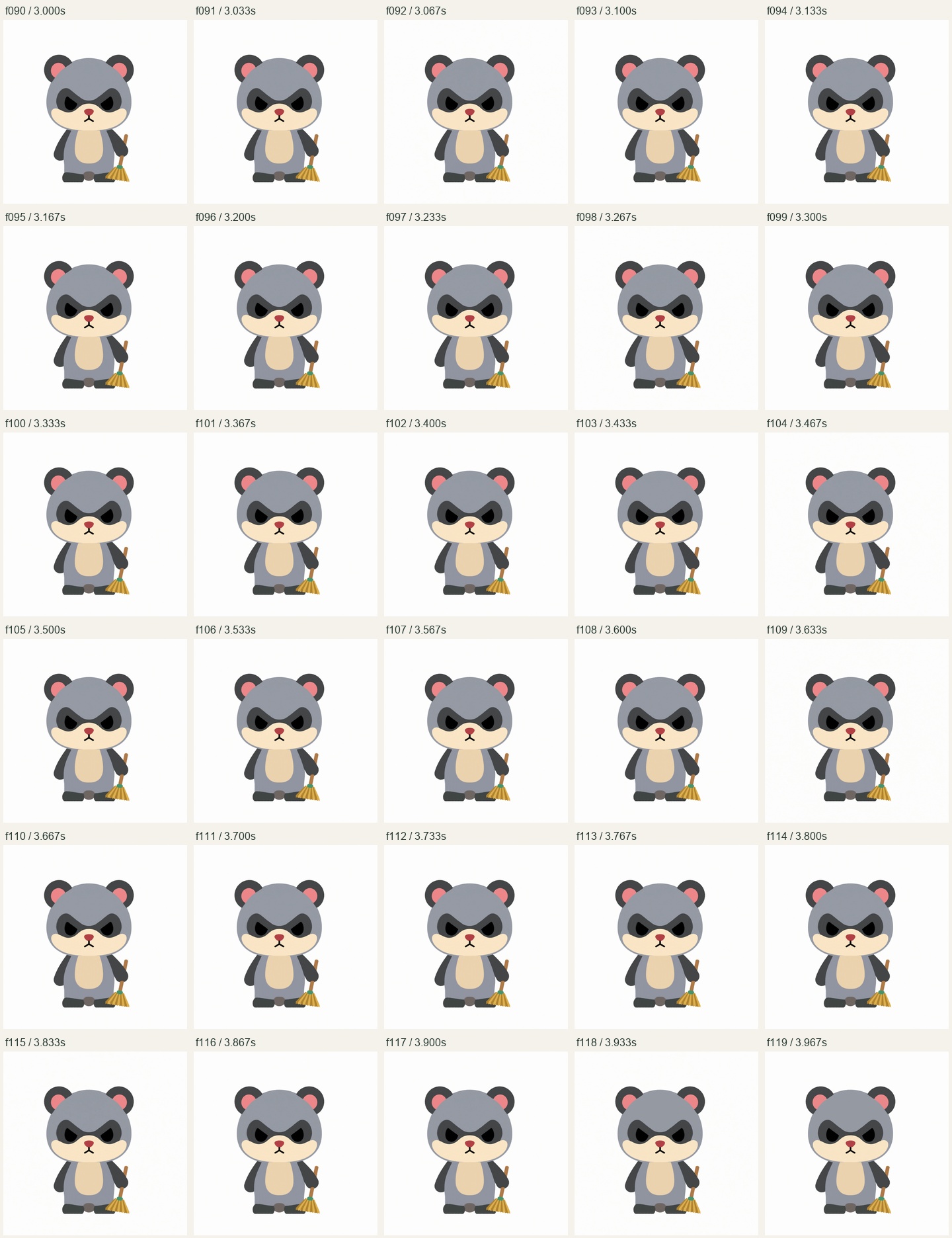 Source frames 90–119
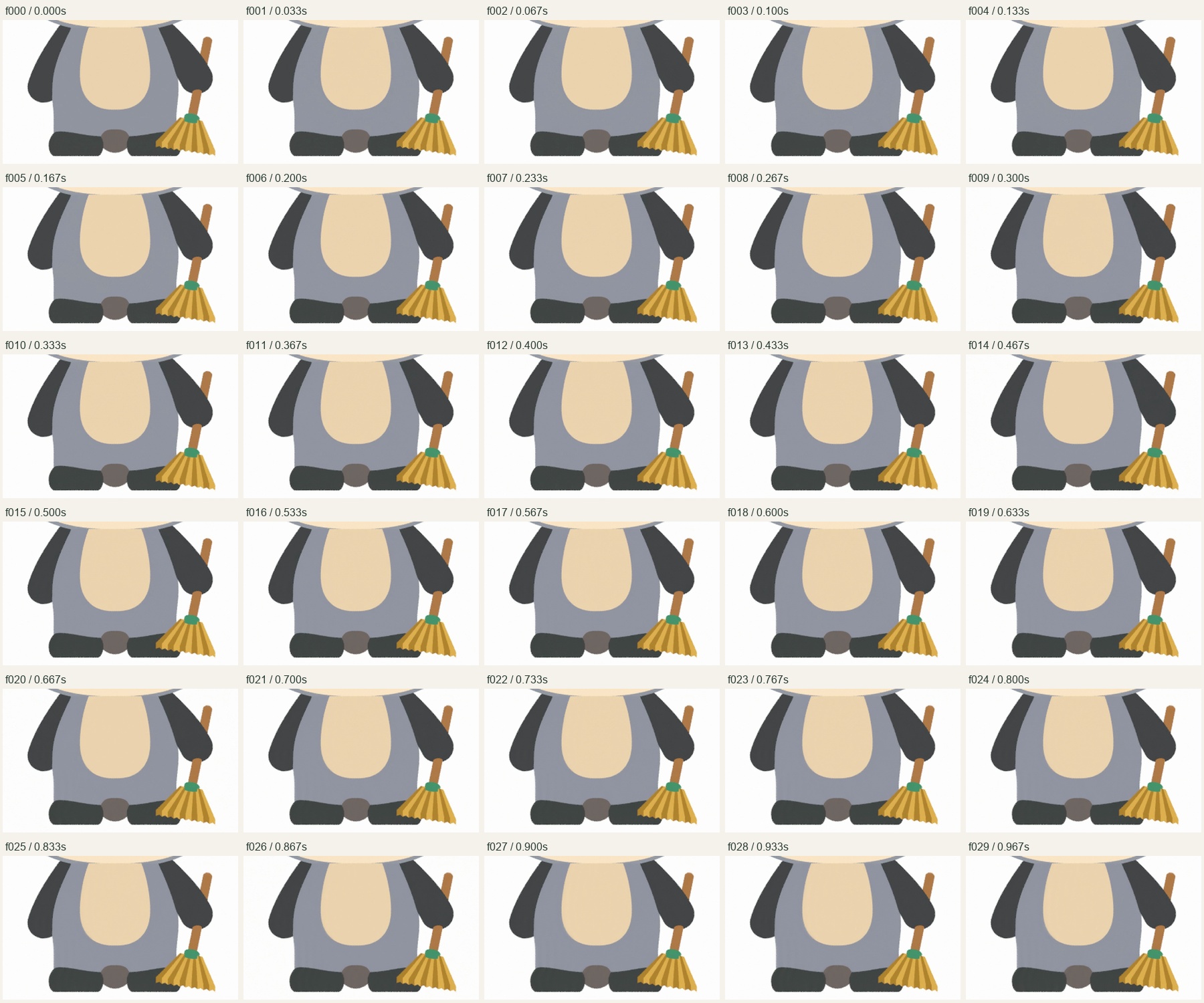 Feet/trunk frames 0–29
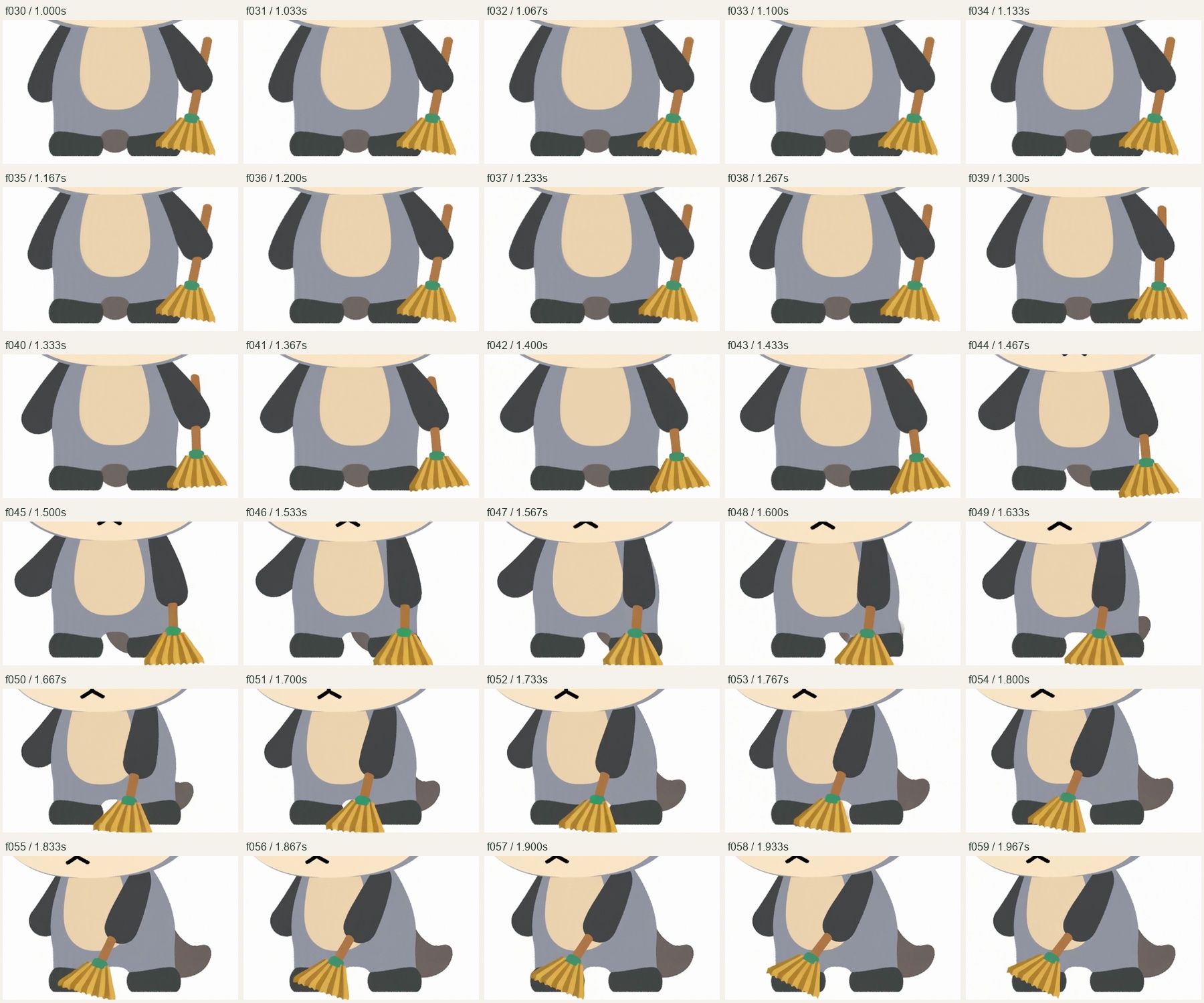 Feet/trunk frames 30–59
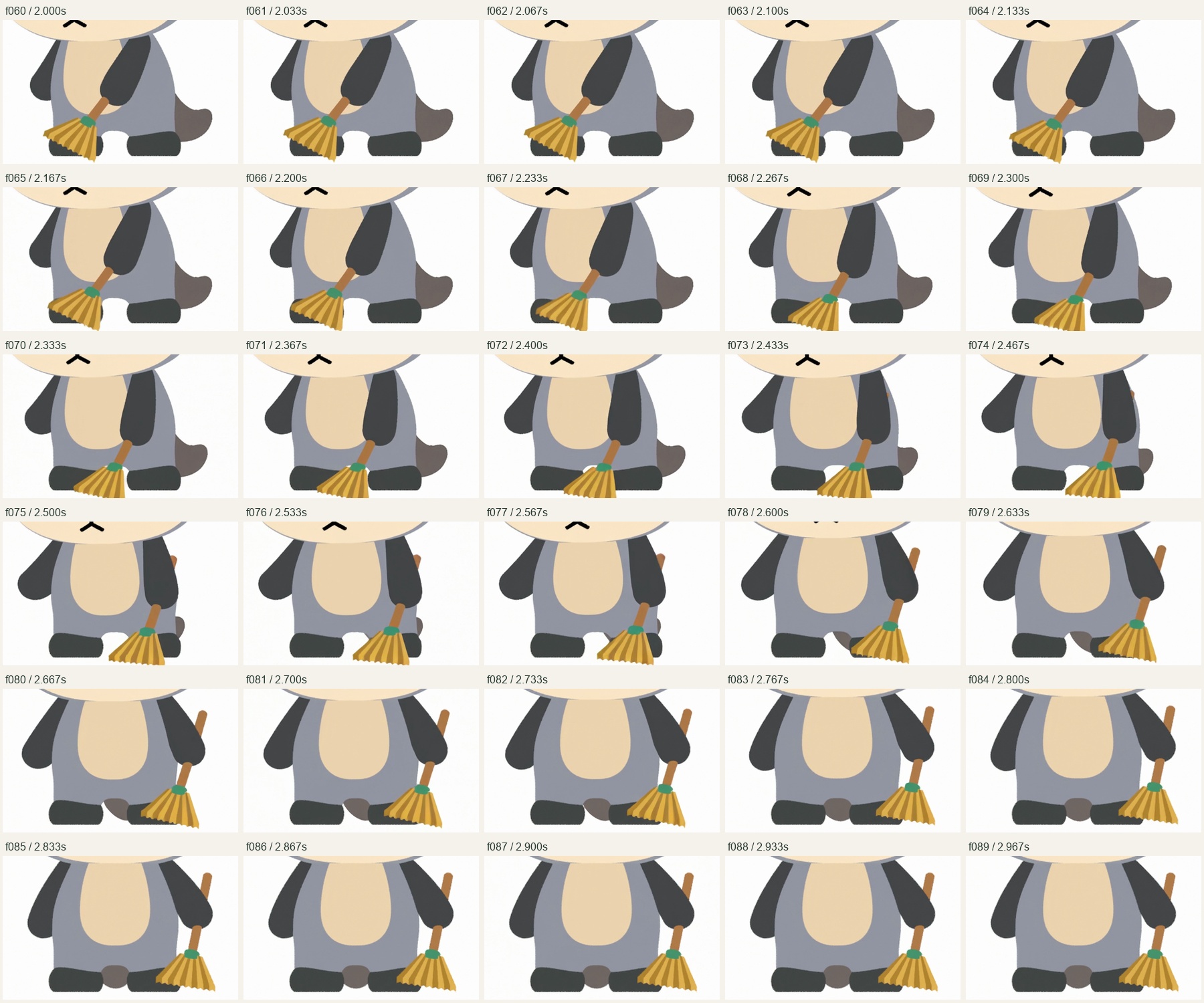 Feet/trunk frames 60–89
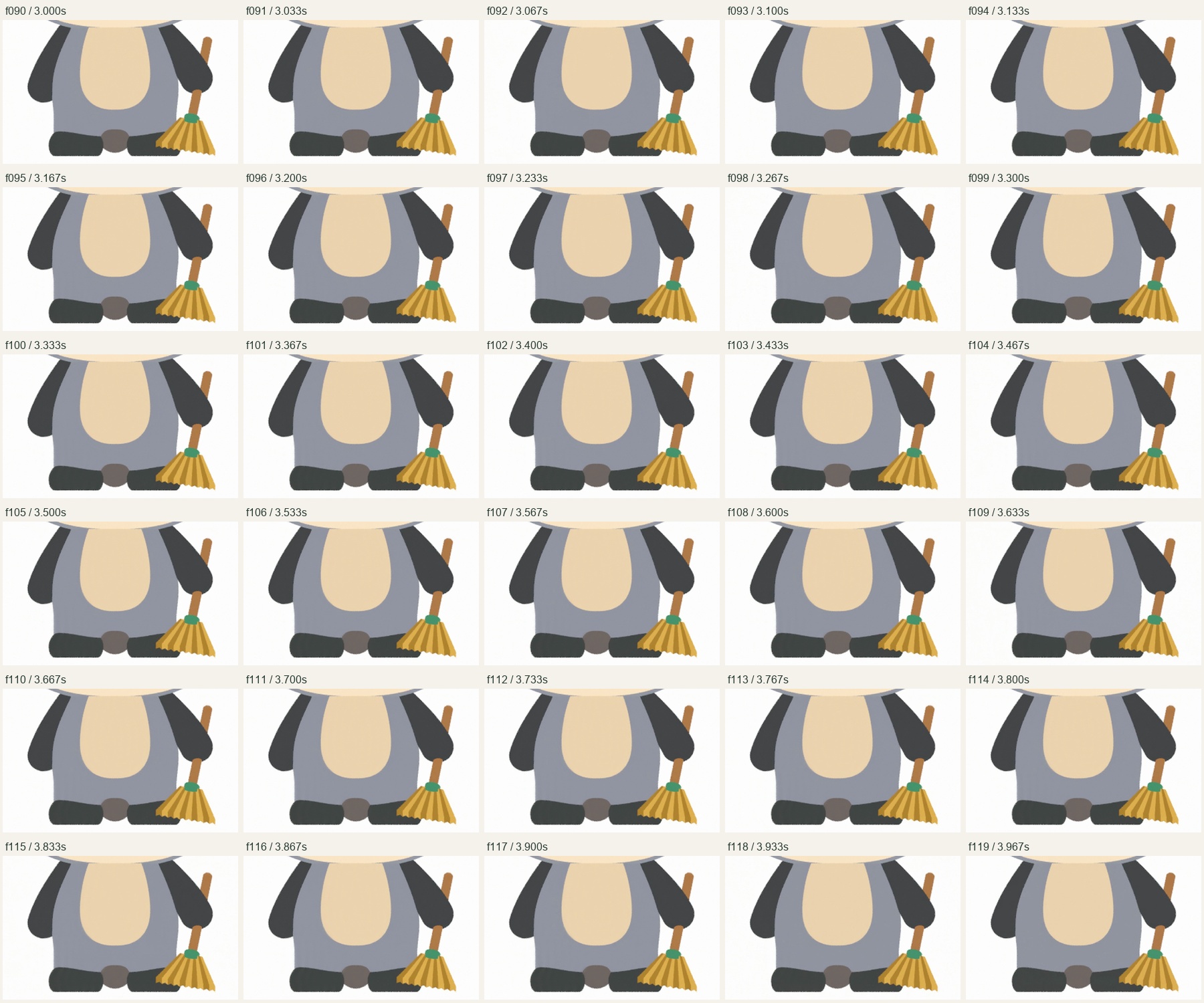 Feet/trunk frames 90–119
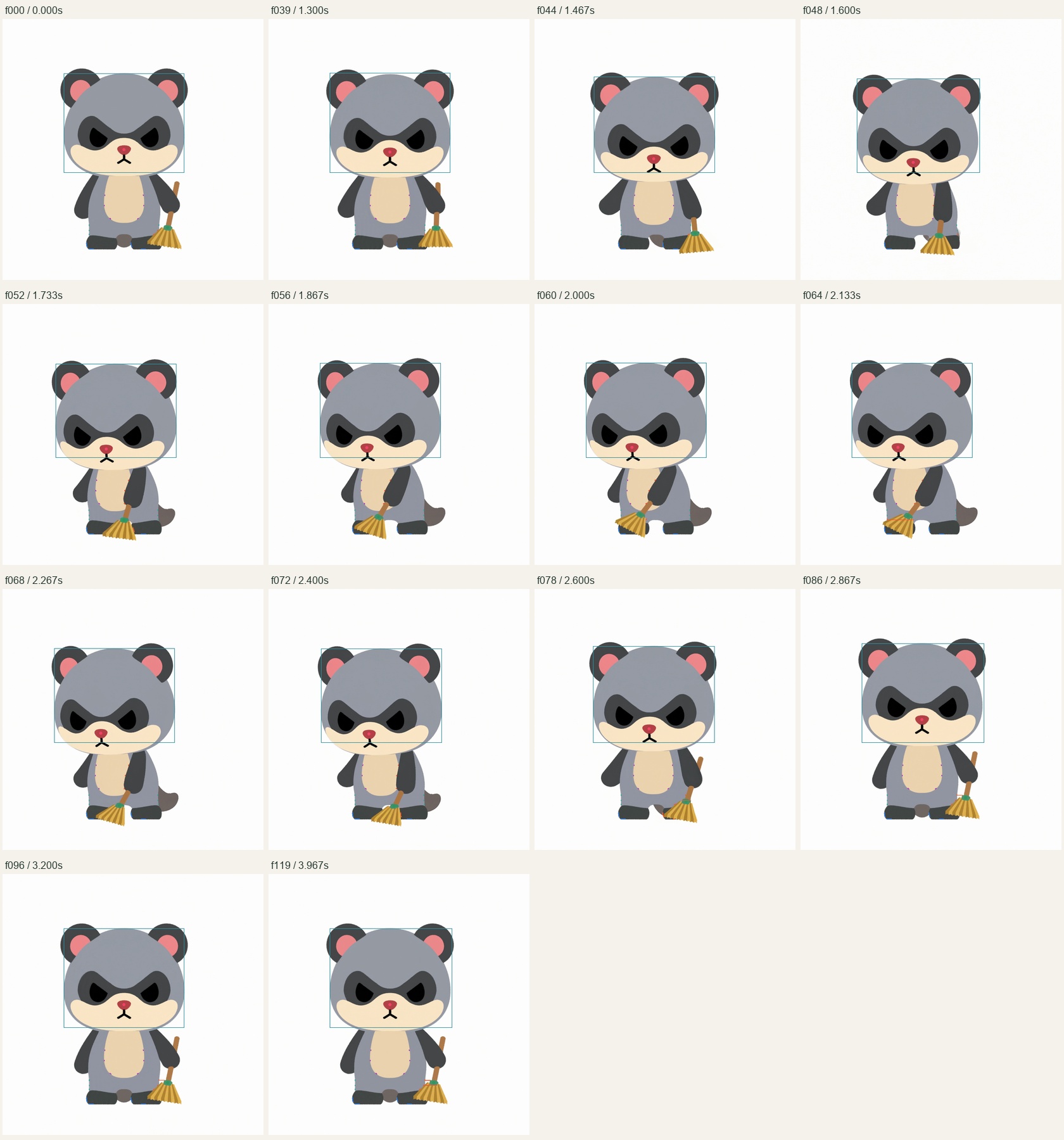 source · 14 annotated keys
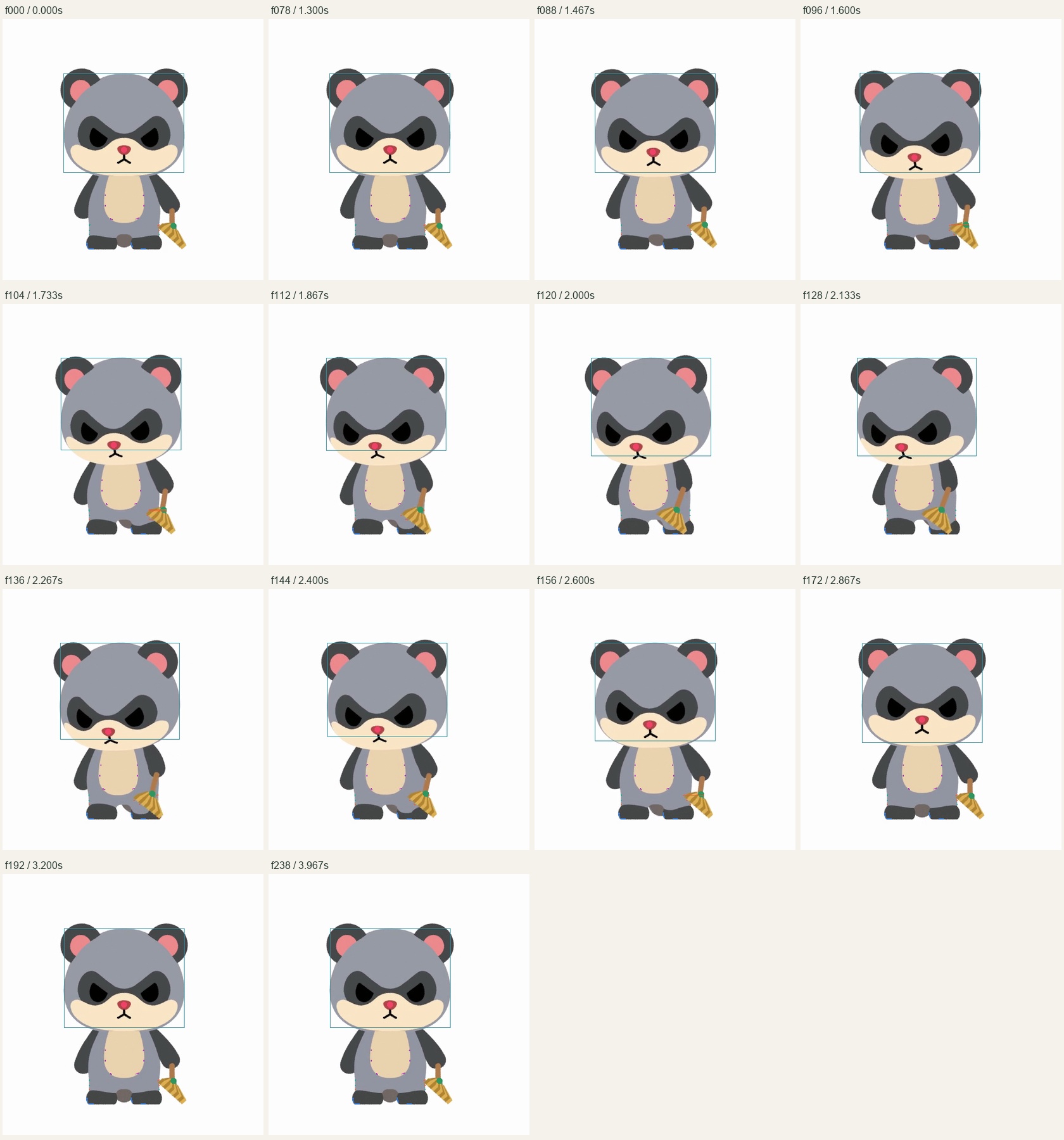 A-common · 14 annotated keys
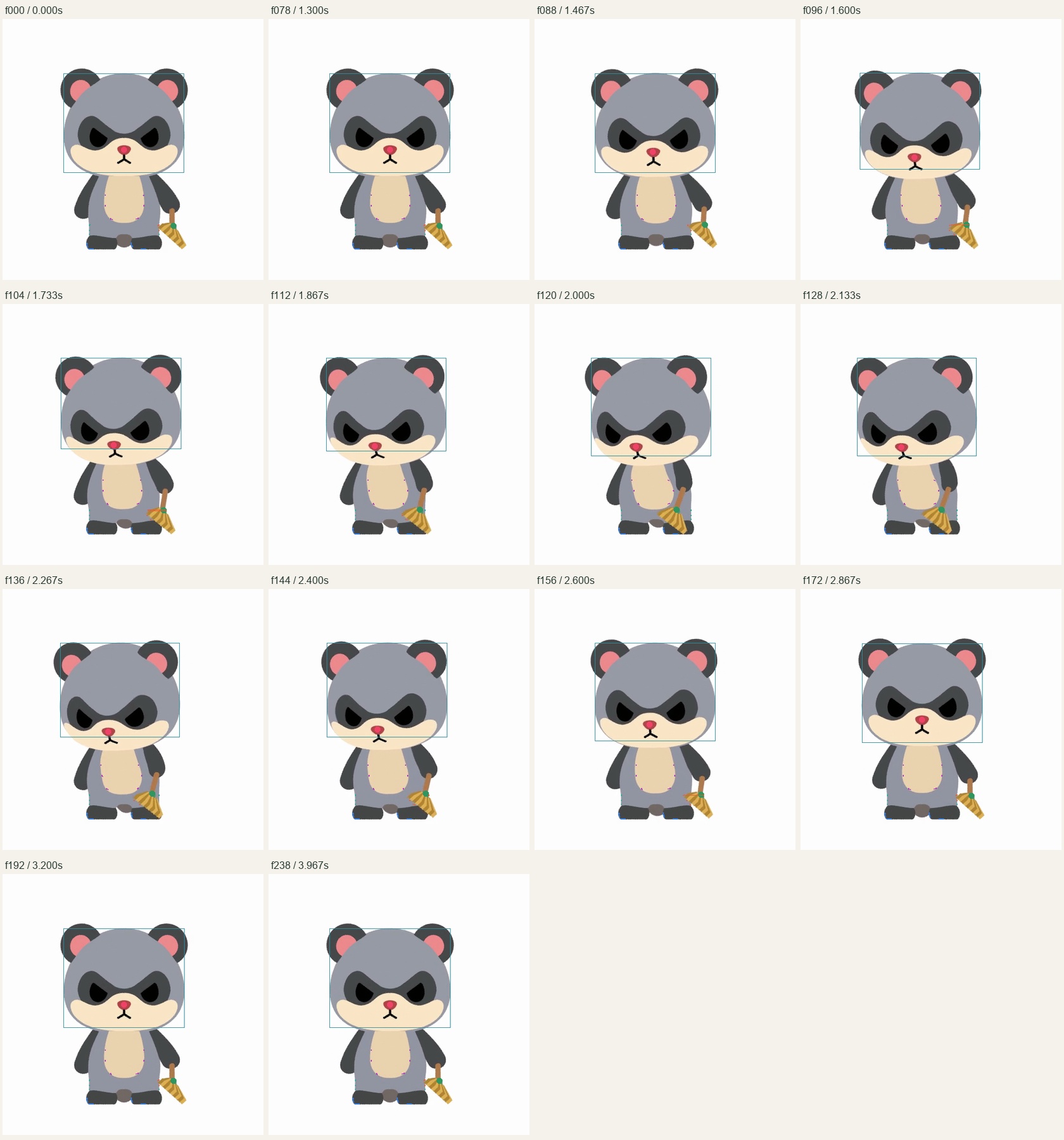 B-articulated · 14 annotated keys
 Feature ownership · source f000
 Feature ownership · source f044
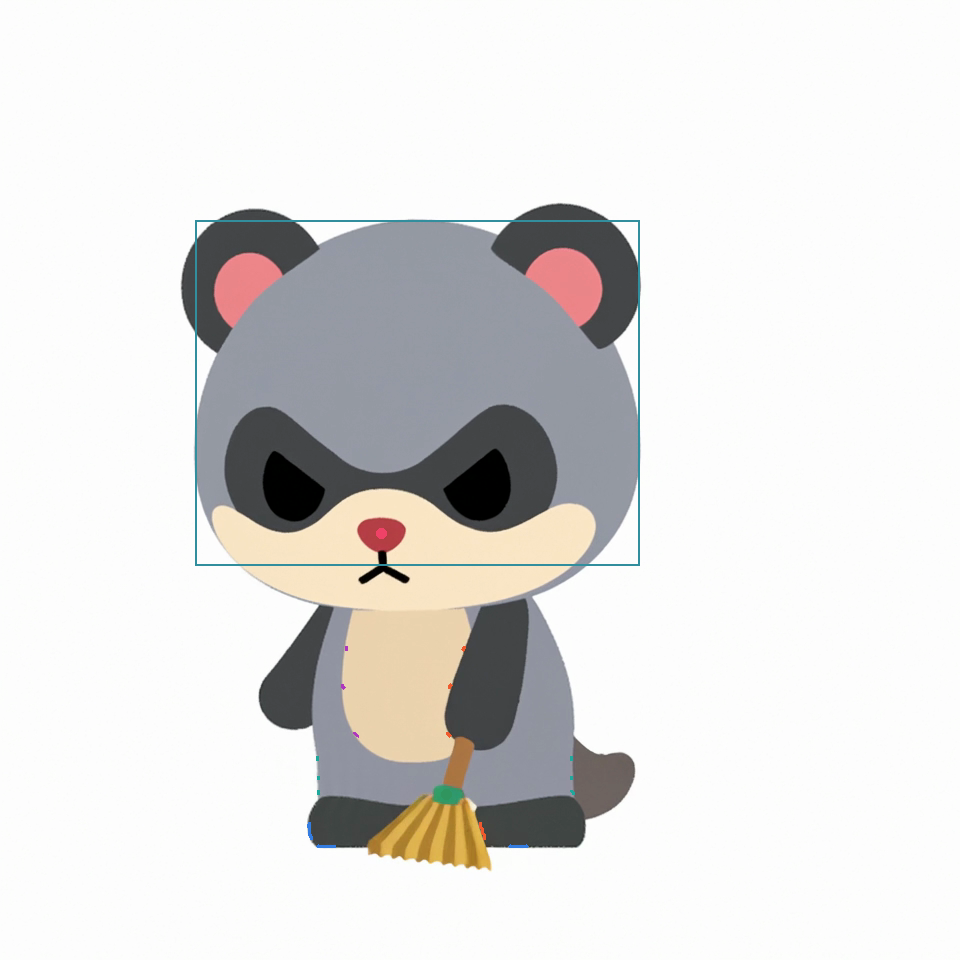 Feature ownership · source f052
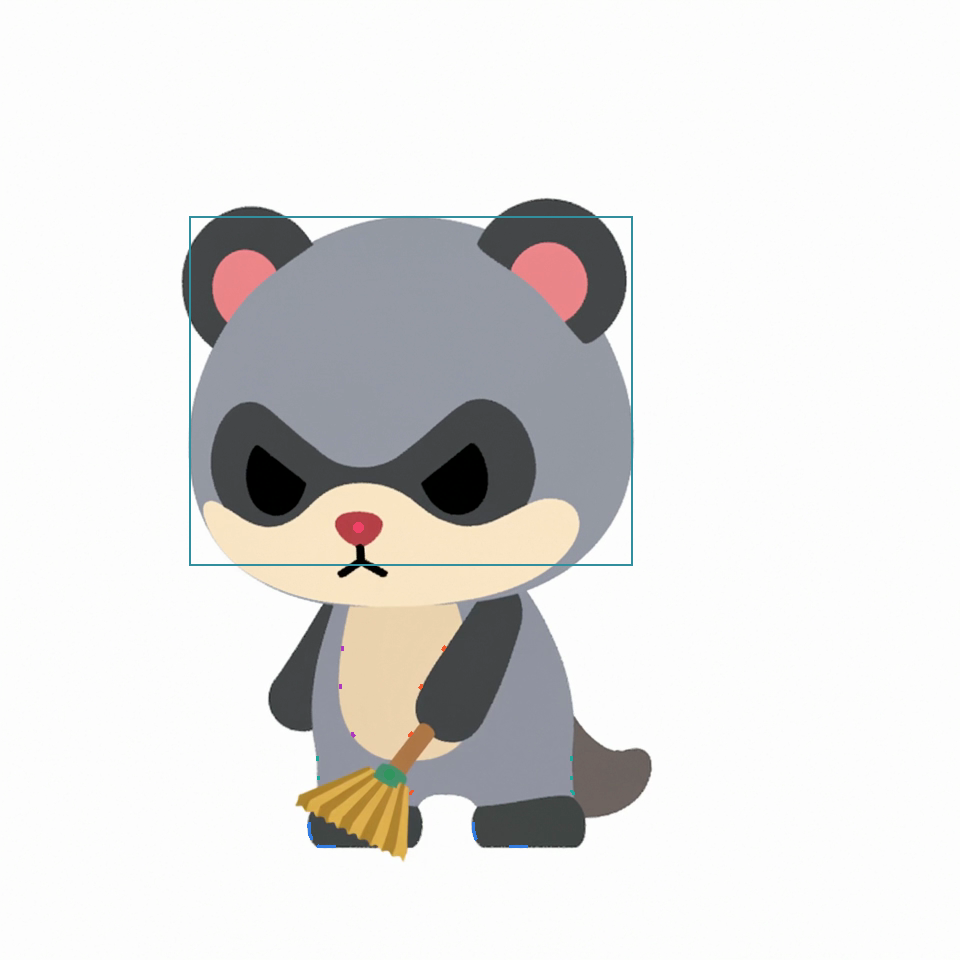 Feature ownership · source f060
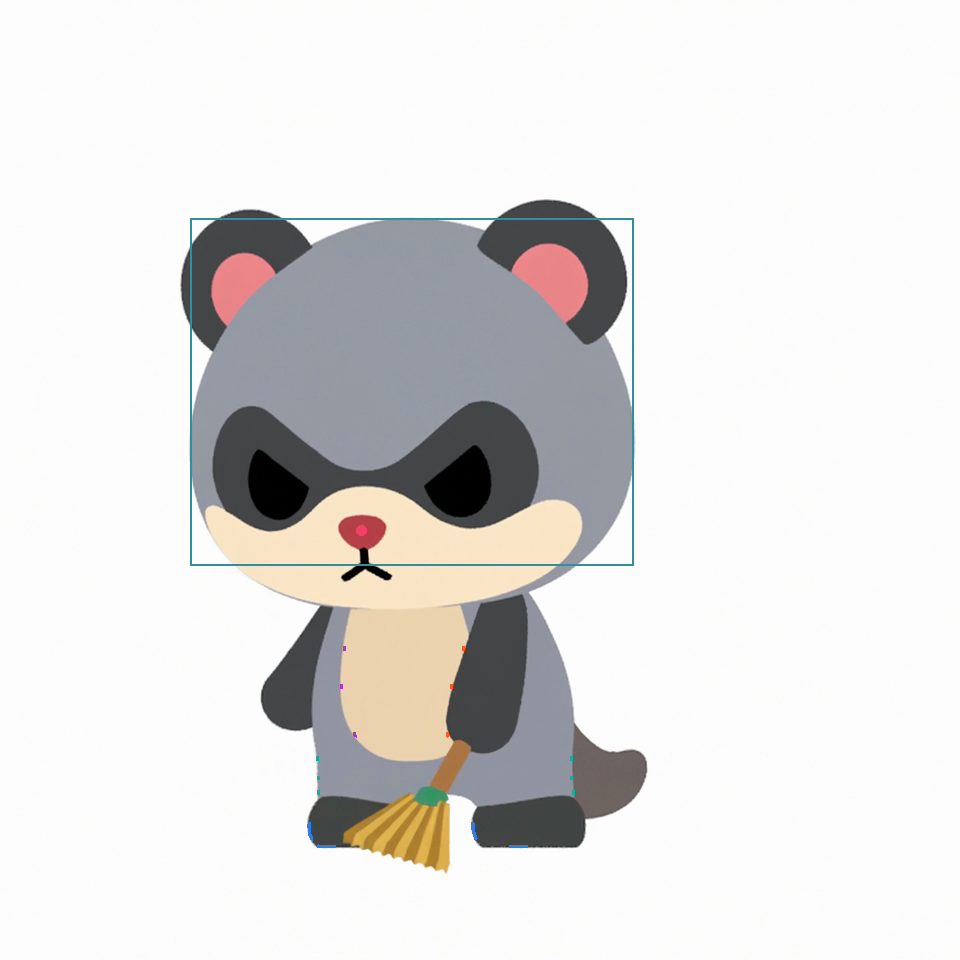 Feature ownership · source f068
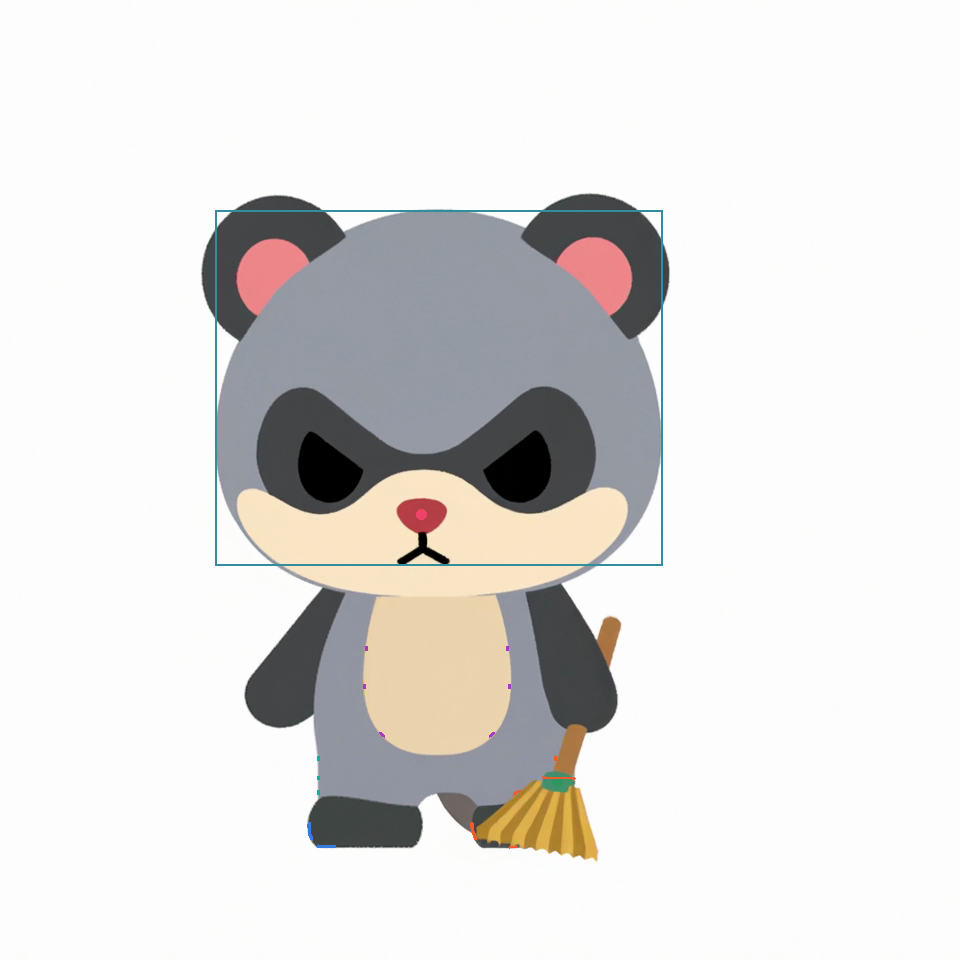 Feature ownership · source f078
 Feature ownership · source f096